Tuesday, May 21, 2013 | by admin
 Investigators have been creating superior wireless brain-computer interfaces (BCI). Being able to shed wires has the promise of enhancing the usability of these devices for those with disabilities. As time goes forward we may increasingly become a wireless neurosociety. This has the potential to irrevocably transform how we relate to others and interact with the environment around us. New tools may enhance our ability to manipulate the world and allow an unprecedented new means of communication with both computers and people.
 Some scientists are additionally working on synthetic telepathy. This research basically entails capturing EEG brain readings that are the neural correlates of our inner monologue. These signals would then be translated by a computer into a voice synthesizer. This would allow a person to correspond with someone else without even opening their mouth. They would merely have to "think" about what they wanted to say and then that could be wirelessly beamed into an ear phone on another person. Theoretically new neuromodulation methods may also be used to artificially generate voices without the need for an ear phone. Brain implants (or perhaps non-invasive ultrasonic neuromodulation using an external device) that stimulated subpopulations of neurons associated with the perception of hearing might allow the creation of hallucinatory sounds. You would be able to perceive someone else talking clearly in your head. This could be useful in the military because this type of communication would generate no audible noise whatsoever. It could allow a two-way dialogue between soldiers using waves on the electromagnetic spectrum.
 Researchers are also developing smart homes that could be controlled by brain computer interfaces. Imagine being able to turn on your television, brighten lights or open doors solely with the power of your own mind. A thought reading helmet that could allow people to fly an airplane with their brain power is in the works as well. So it seems possible that a single sophisticated BCI may enable a person to exert control over their house, their car and communicate with others telepathically. Also, why type on a keyboard when you can just employ thoughts to disseminate information to your computer? All of your inner monologue could be continuously and automatically written down for you on a word software program.
 Brain computer interfaces of the future may both decipher brain signals and manipulate them as well. Better deep brain stimulation implants are already finding increased utilization among people with specific disorders. Complex computer controlled brain stimulation may increasingly become the norm. However, there may be many issues that come up with regards to this new technology. These devices have the potential of being hacked by outsiders. Researchers have begun to consider the ramifications of these types of privacy issues for DBS implants. The fact that they now have wireless inputs means that they can be maliciously hijacked or spied upon by another person.
 In a future society, some people may adopt more drastic types of implants for themselves. Being able to access information from the web and have it beamed directly into your head could be a tremendous boon for learning. The rate at which people acquire and manipulate data would increase at a tremendous rate. However, these types of direct connections to the net also bring up the same issues of privacy as with the less sophisticated neural gear. More complicated brain apparatuses might be susceptible to contracting some sort of virus that could radically alter the functioning of the appliance.
 Imagine if you had a brain implant to improve memory and it stored a copious amount of information. A virus transferred by a wireless signal could possibly rewrite specific types of past recollections, thus altering everything about your previously remembered life history. Or perhaps a hacker or rogue AI program might adjust a person's behavior in a specific way. Maybe they could gain a top level control over someone else and turn them into some sort of botnet drone. Also other people might be able to gain direct access to the private introspection of another person. A wireless brain computer interface that recorded thoughts could potentially be spied upon, much like computers connected to the internet can be today by spyware. This may give a person or government insight into what someone was contemplating ahead of time. Certain countries might gravitate towards this possibility of better controlling or understanding their own citizens. Specific companies might also want the chance to broadcast advertisements wirelessly to a person's brain or gain access to what sorts of products the person would want to buy. If you can hear these messages within your head, how do you prevent your mind from being overrun by spam?
Some people may actually choose to allow others to eavesdrop on their own cognitive processes. This would be analogous to how many people use twitter to broadcast some of their succinct ruminations to whoever will listen. You could potentially selectively choose who you want to overhear your thoughts and block others from access. Will people in the future use neuromodulatory techniques to shed their inhibitions and allow a totally open society? A sousveillance where anyone can listen in on anyone else's internal monologue? Maybe a minority of people would even prefer to have outsiders control their behavior to a certain extent with targeted rewarding brain stimulation or another type of computer controlled mind manipulation.
Perhaps in the future we will also be able to send and receive nuanced emotions along with thoughts. A brain implant could acquire signals and then stimulate brain regions associated with certain feelings. This would be the next step in human evolution and would supercede regions of the mind currently involved in empathetic awareness. We would finally be able to truly feel others joy and pain directly instead of the roundabout way we currently do. I think there are a few other interesting question pertaining to this for future scientists to figure out. A main one being; how much of our consciousness or emotions can we transmit by using electromagnetic radiation?
Many of these things are now highly speculative. Brain-computer interfaces still have a long ways to go before they would have some of these capabilities. The adoption of any said technology may also depend on how easy or practical it is to use. The actual utilization of BCI's rests on the vagaries of future human desires and not what may theoretically be possible. However, there is definitely a lot of interest in improving this sort of technology. BCI's are already entering the market to enable people to play video games with their minds, for instance. So there are a number of interesting future scenarios that could crop up as time goes forward. A wireless neurosociety could potentially be a significant change from what people are currently accustomed to.
Labels: Brain-Computer Interface
| by admin
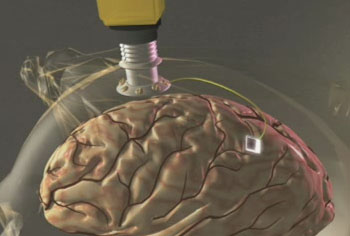 I found some more information about the HIVE project. A presentation was given November of last year discussing the potential of computer controlled brain stimulation (see PDF). The researchers definitely appear to have an eye towards some more futurist speculative uses of the technology.
10 Mapping our brains to computers (the singularity)There is also a new article in AlphaGalileo about it as well. Here's an excerpt (translated from spanish);
9 Jacking in (invasive interaction)
8 Non-invasive Brain 2 Machine + Machine 2 Brain interaction
7 Immersion (HMD/CAVE + haptics + ...) (also MR/AR) using natural senses
One case of possible application that this (technology) poses to the future researcher Pablo de Olavide is in the treatment of some types of deafness. In this line, the device developed could be applied within a few years to develop a stimulus pattern that simulates human speech or sound, for people who can not hear through the ear, can get the information directly into your brain. In these cases, the inner ear that fails, not the brain, so the device could be applied to stimulate the brain related to hearing," concludes the researcher.Beaming sensory experiences into the brain could be helpful for those with certain disabilities. Scientists have also been utilizing brain research in order to facilitate the development of more engrossing and authentic virtual realities. Due to increases in GPU power, virtual environments will likely become more representative of actual real world circumstances as time goes forward. More theoretical technology might eventually enable computer generated sensations to be directly transmitted into the minds of normal people. I think some intriguing things could happen as this field matures. Being able to generate any sort of qualia on command via a digital program is basically the ultimate end point. Coupling that ability with more exact methods of fine tuning how the brain actually perceives qualia could usher in a transformative shift in consciousness.
Labels: Brain-Computer Interface